
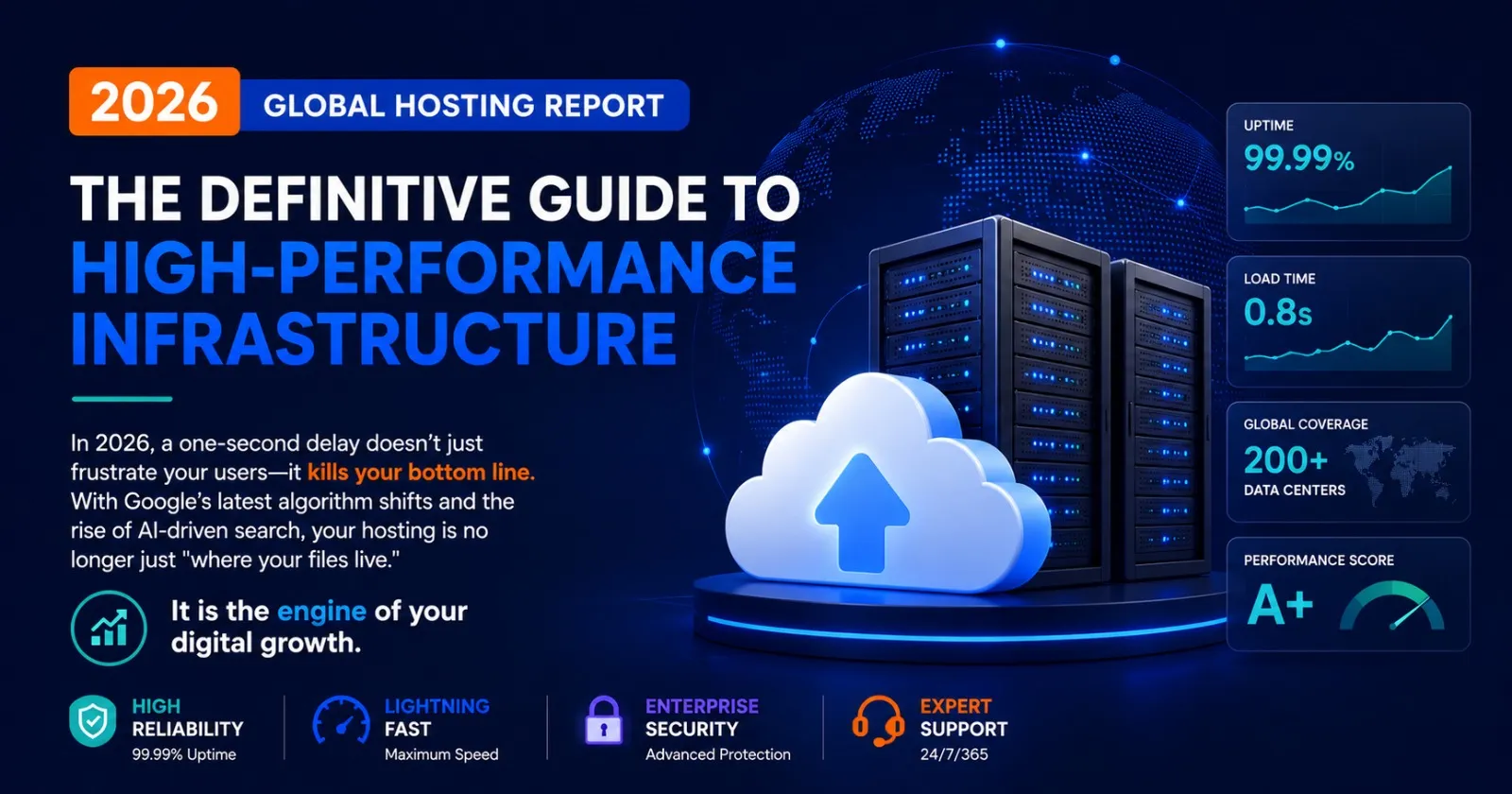
Global Hosting report : the definitive guide to High performance infrastructure 2026
In 2026, a one-second delay doesn’t just frustrate your users it kills your bottom line. With Google’s latest algorithm shifts and the rise of AI-driven search, your hosting is no longer just “where your files live.” It is the engine of your digital growth.
The era of “good enough” hosting is officially over. Today, the difference between a thriving US enterprise and a ghost town website comes down to milliseconds, edge computing proximity, and AI-integrated security protocols. As the American market becomes more saturated, your choice of infrastructure is either your greatest competitive advantage or your most expensive bottleneck.
Whether you are scaling a viral e-commerce brand, launching a resource-heavy SaaS, or building a high-traffic media empire, the hosting landscape has shifted beneath your feet. In this comprehensive 2026 report, we strip away the marketing jargon to reveal the global leaders dominating the industry. We’ve stress-tested the titans—from Hostinger and SiteGround to the powerhouse architectures of WP Engine and Cloudways—to help you decide where your business belongs.
Stop settling for uptime; start demanding performance. Here is the state of global hosting in 2026.
The AI revolution : when your server starts thinking for you

The biggest shift in 2026 isn’t about more RAM or faster CPUs; it’s about the integration of “Autonomous Infrastructure Management.”
For years, web hosting was a static service. You bought space, and you managed the headaches. Today, the global leaders have pivoted to AI-native environments. What does this mean for your business? It means Predictive Resource Scaling.
Gone are the days when a sudden traffic spike from a viral social media post or a successful ad campaign would crash your site. Modern leaders like Cloudways and SiteGround now utilize machine learning algorithms that analyze traffic patterns in real-time. If a surge is detected, the system autonomously allocates virtual resources before your latency increases.
But the “intelligence” doesn’t stop at performance. In 2026, security has moved from reactive to proactive:
- AI-Threat Hunting: Instead of waiting for a known virus signature, your host now uses behavioral analysis to block polymorphic malware and sophisticated bot attacks in milliseconds.
- Automated SEO Optimization: Some premium hosts now include AI-driven image compression and code minification that adapt specifically to the device your visitor is using, ensuring your Core Web Vitals stay in the green without you lifting a finger.
The Verdict: If your current provider isn’t offering AI-driven optimization, you aren’t just behind the curve you’re paying for an obsolete service.
2026 head to head : the Best Hosting providers for the US market

Our Selection Process
Choosing a host actually isn’t just about finding the cheapest plan; it’s about infrastructure reliability. For this 2026 comparison, we evaluated dozens of providers based on four non-negotiable pillars :
- TTFB (Time to First Byte): Response times from US-based servers (East, West, and Central).
- Scalability: How easily you can jump from 1,000 to 100,000 monthly visitors
- Customer Success: Availability and technical depth of 24/7 US support
- Transparent Pricing: No hidden renewal traps or “essential” add-ons that should be free
|
Provider |
Best For… |
Starting Price (US) |
Performance Score |
Our Rating |
|
Hostinger |
Budget & Solopreneurs |
$2.99/mo |
9.2/10 |
⭐⭐⭐⭐☆ |
|
SiteGround |
Managed WP & Support |
$3.99/mo |
9.5/10 |
⭐⭐⭐⭐⭐ |
|
WP Engine |
High-Traffic Enterprise |
$20/mo |
9.8/10 |
⭐⭐⭐⭐☆ |
|
Cloudways |
Scaling & Tech Control |
$14/mo |
9.7/10 |
⭐⭐⭐⭐⭐ |
Detailed Analysis
1. Hostinger: The Value Leader
Hostinger has dominated the “affordable” segment by offering premium-tier hardware (NVMe storage) at entry-level prices. In 2026, their AI-powered website builder and hPanel have become remarkably intuitive for beginners.
- The Pros: Incredible speed for the price, free domain and SSL included, and an extremely user-friendly interface. Their data centers in the US (USA-East and USA-West) deliver consistent low latency.
- The Cons: Their support, while helpful, is primarily chat-based, which can lead to longer wait times during peak hours. Renewal prices are significantly higher than the introductory rates.
- Our Rating: 4.5/5
2. SiteGround: The Gold Standard for Support
SiteGround remains the favorite for small business owners who want peace of mind. Their custom-built speed stack (Google Cloud-based) is one of the most stable in the industry.
- The Pros: Legendary customer support (often responding in under 30 seconds). Their “SuperCacher” technology makes WordPress sites fly. Free daily backups are a standard.
- The Cons: Storage limits are stricter than competitors. If you have a very large media library, you will hit the cap quickly and be forced to upgrade.
- Our Rating: 4.8/5
3. Cloudways (by DigitalOcean): For the Growth-Obsessed
Cloudways isn’t traditional hosting; it’s a managed cloud platform. It allows you to choose your infrastructure (DigitalOcean, Vultr, AWS) while they handle the server management.
- The Pros: Total flexibility. You pay for what you use (Hourly billing). The performance is unmatched because you have dedicated resources—no sharing with other websites.
- The Cons: There is a slight learning curve. Even though it’s managed, it’s more technical than a standard dashboard like Hostinger. There is no email hosting included (you’ll need Google Workspace or Rackspace).
- Our Rating: 4.7/5
The Final Verdict: Which One Should You Choose?
- The #1 Choice (Overall Winner): SiteGround. For 90% of our readers, the combination of Google Cloud speed and world-class support justifies the slightly higher price. It’s the most “set it and forget it” solution available.
- The Budget Alternative: Hostinger. If you are just starting out and every dollar counts, you won’t find better hardware at this price point. Period.
- The Scalability King: Cloudways. If you are running heavy Facebook Ads or expect viral traffic, don’t trap yourself in a shared environment. Go with Cloudways.
5. Kinsta: The “Ferrari” of Managed Hosting
If price is your only metric, skip this section. But if your website is a revenue-generating machine where every millisecond of downtime costs you a fortune, welcome to the gold standard.
Kinsta is not just an alternative; it’s an upgrade to a different league. Built exclusively on the Google Cloud Platform’s Premium Tier network, it is designed for one thing: raw, uncompromising speed for high-traffic E-commerce and enterprise sites.
- The Pros: They utilize C3D virtual machines—the fastest infrastructure Google Cloud offers. Their “Edge Caching” isn’t just a buzzword; it physically places your store’s data on 260+ global locations, ensuring a shopper in New York and one in Tokyo both get sub-second load times.
- The Cons: The premium performance comes with a premium invoice. It is the most expensive option on this list, and unlike “all-in-one” hosts, they focus strictly on hosting—meaning you’ll need to manage your domain and email elsewhere.
- The “White-Glove” Edge: The biggest barrier to switching hosts is the fear of breaking your site. Kinsta eliminates this with their Unlimited White-Glove Migrations. Their expert engineers handle the entire move for you, ensuring zero downtime and a perfect transition. You literally hand them the keys, and they park your site in its new, faster home.
Our Rating: 4.9/5 (Performance) | 3.5/5 (Affordability)
Conclusion & Final Verdict: Your 2026 Roadmap
Choosing a host in 2026 is about matching your infrastructure to your ambitions. Here is the final breakdown to help you click “Buy” with confidence:
- The All-Rounder: Choose SiteGround if you want the best balance of speed, security, and human support.
- The Budget Hero: Choose Hostinger if you are launching your first project and need the best hardware for under $5.
- The Tech Powerhouse: Choose Cloudways if you want total control over your cloud environment and pay-as-you-go flexibility.
- The Luxury Choice: Choose Kinsta if you run a high-revenue E-commerce store and want a “hands off” premium experience where performance is guaranteed.
FAQ: What US Business Owners are Asking in 2026
Q: Does server location still matter with modern CDNs? A: Yes. While a CDN caches your static files (images, CSS), the “brain” of your site (the database) still lives on the origin server. For a US audience, having an origin server in Iowa, South Carolina, or Oregon still provides a significant SEO and UX advantage.
Q: Is “Green Hosting” a real requirement now? A: In 2026, it’s a branding necessity. Over 60% of US consumers prefer buying from brands with a lower carbon footprint. Choosing a host like SiteGround or Kinsta (using Google’s carbon-neutral data centers) is a win for your PR and the planet.
Q: Can I change my host later if I grow? A: Absolutely. However, starting with a scalable provider like Cloudways or Kinsta saves you the technical debt of a messy migration later.