How much does web hosting cost? Real prices, no surprises
Affiliate Disclosure: This article contains affiliate links. If you purchase a hosting plan through one of our links, we may earn a commission at no extra cost to you. Our recommendations are based on independent research and real-world testing. We only recommend services we genuinely trust.
Knowing how much does web hosting cost before you sign up is the single most effective way to avoid the budget surprises that catch thousands of American site owners off guard every year. The advertised price is real, but it is rarely the whole story. You pick a plan at $2.95 per month, enter your payment details, and somehow the checkout total is $40 more than you expected. There is an SSL certificate add-on, a domain privacy fee, a site backup upgrade, and a setup charge you did not notice until it was too late.
Understanding how much does web hosting cost at each tier, and where the extra charges come from, puts you in a much stronger position than most buyers. If you are still figuring out which type of hosting fits your situation, our complete beginner’s guide on how to choose a web hosting service in 2026 covers that decision from the ground up. This page focuses entirely on the money side.
Before we get into the numbers, the host we recommend most often for readers looking for transparent, honest pricing is [] Hostinger [], which clearly displays both promotional and renewal rates on their pricing page without burying the information in fine print.
[] Visit Hostinger – See Transparent Pricing []
Why hosting prices look lower than they are
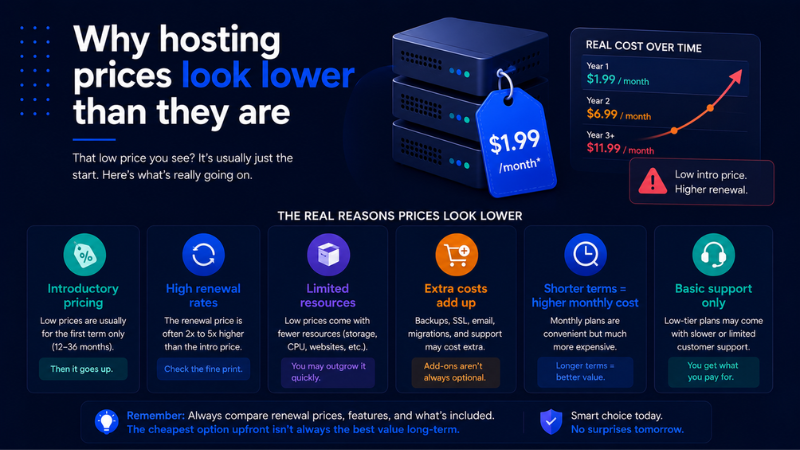
The web hosting industry runs on a pricing model that front-loads discounts to attract new customers and then charges significantly more at renewal. Understanding how much does web hosting cost over time, not just for the first term, is what separates informed buyers from frustrated ones.
A shared hosting plan advertised at $2.95 per month is almost always a promotional rate available only when you prepay for 12, 24, or 36 months upfront. That means you are paying $35.40 for the year at the promotional rate. When that term ends, the same plan renews at the standard rate, often $8.99 to $12.99 per month, or $107 to $155 for the year.
That is not a bait-and-switch in the legal sense. The renewal rate is disclosed in the terms of service. But it is buried, and most people do not read it before buying.
The three prices you need to find before signing up
Before committing to any hosting plan, track down three specific numbers.
The promotional price is what the host advertises. It applies only to your first term and requires prepaying for 12, 24, or 36 months to access. This is the number on the sales page.
The renewal price is what you pay when that initial term ends. This is the price you will pay for years two, three, and beyond. It is the number that actually determines how much does web hosting cost for your site over time.
The total first-year cost is the promotional price multiplied by the contract length, plus any mandatory add-ons at checkout. This is your actual out-of-pocket expense for year one and the only honest basis for comparing two hosting plans side by side.
Most reputable hosts list renewal pricing on their pricing page if you look carefully. If a host makes it genuinely difficult to find the renewal rate before checkout, that tells you something about how they operate.
Why the renewal price matters more than the promotional price
Most site owners focus entirely on the promotional price when comparing hosts. That is exactly what hosting companies want. The promotional price is a marketing tool. The renewal price is the real cost of hosting your website.
Here is a simple example. Host A charges $2.95 per month promotional and $12.99 per month at renewal. Host B charges $4.95 per month promotional and $7.99 per month at renewal. Over three years, Host B costs significantly less despite having a higher promotional price. Knowing how much does web hosting cost over the full contract period, not just year one, changes the comparison completely.
Real pricing by hosting tier
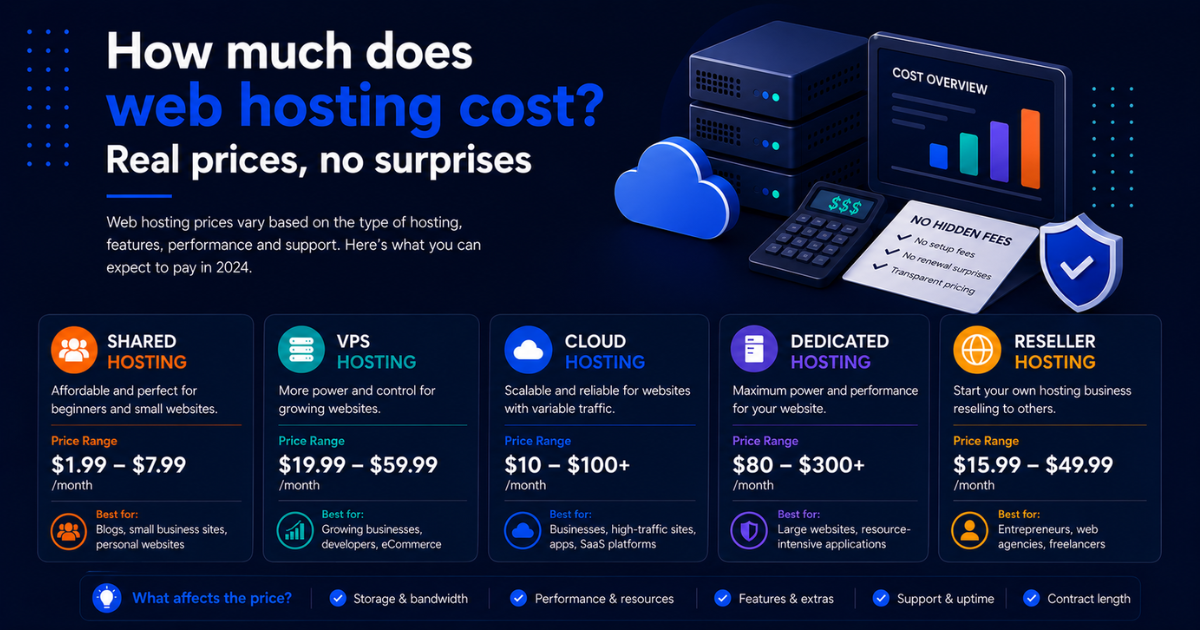
Here is what you should actually expect to pay based on current market rates across reputable providers. These are real ranges, not promotional minimums.
Shared hosting: $2 to $15 per month
Shared hosting is the entry-level tier and the most price-competitive segment of the market. How much does web hosting cost at this tier? Promotional rates from established providers typically fall between $2 and $5 per month on annual plans. Standard renewal rates run $8 to $15 per month.
Within shared hosting, most providers offer two or three tiers. The differences between tiers usually come down to the number of websites you can host, storage allocation, email account limits, and access to premium features like staging environments or advanced caching.
For a single website with moderate traffic, the basic entry-level shared plan is almost always sufficient. Do not pay for unlimited websites if you are only running one.
VPS hosting: $20 to $100 per month
How much does web hosting cost at the VPS tier? VPS pricing is more straightforward than shared hosting because the promotional rate versus renewal rate gap is usually smaller. Managed VPS plans run $30 to $80 per month for a configuration adequate for most growing websites. Unmanaged VPS starts around $10 to $20 per month but requires you to administer the server yourself.
The primary variables that drive VPS pricing are CPU cores, RAM, storage type, bandwidth allocation, and data center location. NVMe SSD storage is meaningfully faster than standard SSD and should be a baseline expectation at this price point.
Cloud hosting: $10 to $200 per month
How much does web hosting cost on a managed cloud platform? Managed cloud platforms offer predictable monthly pricing ranging from $10 to $200 depending on resources and the underlying cloud infrastructure provider. Raw cloud platforms like AWS and Google Cloud use consumption-based billing that scales with usage, which is powerful for large operations but unpredictable for newcomers who are not monitoring resource consumption closely.
Dedicated hosting: $80 to $400 per month
How much does web hosting cost on a dedicated server? Entry-level dedicated servers start around $80 per month. A well-configured modern dedicated server with current-generation CPUs, NVMe storage, and 32GB or more RAM runs $150 to $300 per month from established providers.
Pricing comparison by hosting tier
| Hosting tier | Promotional rate | Typical renewal rate | Avg. year one cost |
|---|---|---|---|
| Shared | $2 to $5/mo | $8 to $15/mo | $35 to $60 |
| VPS managed | $20 to $40/mo | $30 to $80/mo | $240 to $480 |
| Cloud managed | $14 to $50/mo | $14 to $150/mo | $168 to $600 |
| Dedicated | $80 to $150/mo | $80 to $300/mo | $960 to $1,800 |
The upsells: what is worth taking and what is not
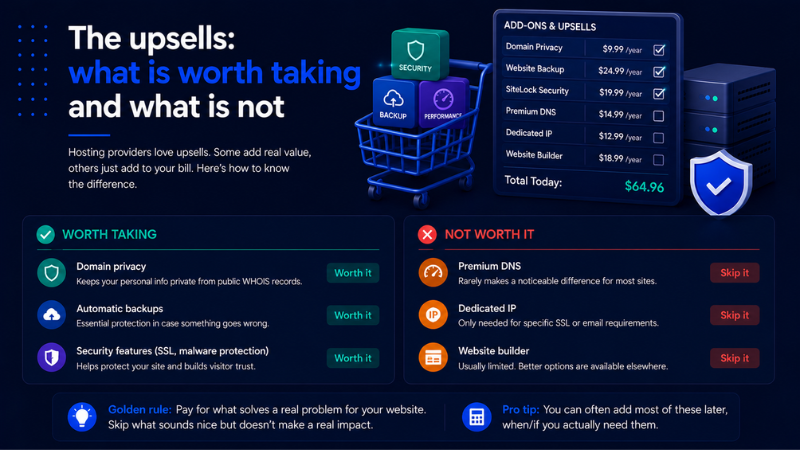
The checkout process for most hosting providers is a series of add-ons. Some of them are genuinely useful. Others are things you can get free elsewhere or do not need at all. Knowing which is which is part of understanding how much does web hosting cost in practice versus how much it needs to cost.
SSL certificate: usually skip it
A few years ago, SSL certificates cost real money. Today, Let’s Encrypt provides free SSL certificates that are automatically installed by most reputable hosting providers. If your chosen host does not include free SSL in 2026, that is a red flag about the quality of their baseline offering, not a reason to pay for the upgrade.
According to Google’s HTTPS transparency report, over 95% of pages loaded in Chrome are now served over HTTPS. Free SSL is a baseline expectation, not a premium feature.
Domain privacy: worth it if it is cheap
When you register a domain, your personal contact information is added to the publicly searchable WHOIS database. Domain privacy replaces your details with the registrar’s proxy information. Most registrars charge $10 to $15 per year. Some registrars like Namecheap and Porkbun include it free, which is one reason registering your domain separately from your hosting often makes financial sense.
Daily backups: evaluate carefully
Automated daily backups are genuinely important. The question is whether you need to pay your host for them. WordPress users can get reliable automated daily backups through free plugins like UpdraftPlus that store copies to Google Drive or Dropbox. If your host’s backup add-on is $2 to $3 per month, it might be worth it for convenience. If it is $8 to $10 per month, a plugin solution is almost certainly a better use of money.
Security scanning: almost always skip it
SiteLock and similar scanning services typically run $2 to $5 per month. Free security plugins available through your CMS provide comparable or better protection at no cost. This is one of the most consistently oversold add-ons at hosting checkout and one of the least necessary.
How to calculate your true first-year cost
Here is the framework I use when comparing hosting plans across providers. It takes about five minutes and gives you a number you can actually compare honestly.
Step one: find the promotional monthly rate and multiply by 12.
Step two: add any mandatory fees at checkout. Domain registration typically runs $10 to $15 per year if not included.
Step three: add any add-ons you have decided to take based on the criteria above.
Step four: note the renewal rate and calculate what year two will actually cost separately.
That four-step calculation gives you two numbers: your true year one cost and your true ongoing annual cost. These are the numbers to compare across providers, not the promotional monthly rate that appears in the headline ad.
A quick cost comparison example
| Provider type | Promo price | Renewal price | Year 1 total | Year 2 total |
|---|---|---|---|---|
| Budget shared host | $2.95/mo | $12.99/mo | $35.40 | $155.88 |
| Mid-range shared host | $4.95/mo | $7.99/mo | $59.40 | $95.88 |
| Premium shared host | $6.99/mo | $9.99/mo | $83.88 | $119.88 |
The budget host looks cheapest in year one. By year two, the mid-range host costs less overall. By year three, the difference compounds further. Knowing how much does web hosting cost over the full contract period changes which option looks most attractive.
Our recommended hosts by budget
For readers who want a direct recommendation based on budget and use case, here is where we send most people after they understand the pricing landscape.
| Budget | Recommended host | Why we recommend it | Deal |
|---|---|---|---|
| Under $5/mo | Hostinger | Transparent pricing, NVMe SSD, honest renewal rates | [] See Deal [] |
| $5 to $15/mo | A2 Hosting | Strong performance, clear pricing, good renewal rates | [] See Deal [] |
| $14 to $50/mo | Cloudways | Usage-based billing, no hidden fees, managed cloud | [] See Deal [] |
| $35 to $100/mo | Kinsta | Premium managed WordPress, transparent pricing tiers | [] See Deal [] |
Web hosting is not expensive relative to what it provides. The frustration is not the price. It is the lack of transparency that makes comparison shopping harder than it should be. Knowing how much does web hosting cost at each tier, which add-ons to skip, and how to calculate the true first-year cost puts you in a much stronger position than most buyers going into their first hosting decision.
Going in with a clear framework, knowing the three prices to find, understanding which add-ons are worth taking, and calculating the true first-year cost before committing, means you will never be caught off guard at checkout or surprised by a renewal bill that doubled without warning.
For readers who want the most transparent pricing structure available today, [] Hostinger [] is where we send most budget-conscious first-time buyers. Their pricing page shows both promotional and renewal rates clearly, which is rarer than it should be in this industry.
[] Visit Hostinger – See Honest Pricing With No Hidden Fees []
Once you have the cost picture clear, the next variable that separates good hosts from mediocre ones is what happens when something goes wrong. Our guide on how to evaluate web hosting customer support before you sign up gives you a practical testing framework you can use before committing to any provider.