Hostinger vs dreamHost: Which web host offers better value in 2026?
Hostinger vs DreamHost is one of the most useful budget-hosting comparisons in 2026 because both providers target beginners, creators, small businesses, and WordPress users, but they package value very differently. Hostinger focuses on low introductory pricing, hPanel, LiteSpeed-powered hosting, AI tools, CDN, email, and a global infrastructure footprint. DreamHost now uses a refreshed Launch, Growth, and Scale lineup with NVMe storage, daily backups, generous website limits, unmetered bandwidth, and a more traditional hosting workflow.
This comparison looks at current pricing, renewals, storage, backups, support, WordPress features, ease of use, and long-term value. I also separate headline promotional pricing from what you’ll actually pay after renewal. If you’re deciding between Hostinger and DreamHost for a blog, small business site, portfolio, or growing WordPress project, the differences are clearer than they first appear.
Hostinger vs DreamHost: quick overview
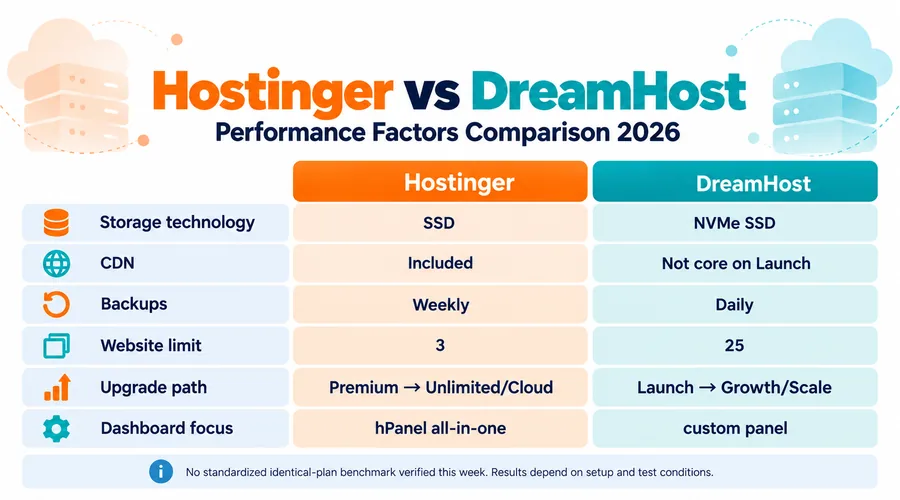
The hostinger vs dreamhost 2026 comparison is close on entry pricing, but the resource mix is very different. Hostinger Premium is cheaper over the initial 48-month term. DreamHost Launch includes far more websites, more storage, and daily backups at the entry level.
| Feature | Hostinger | DreamHost |
|---|---|---|
| Entry plan | Premium | Launch |
| Intro price | $2.99/mo on current 48-month term | €2.89/mo for 1 year on current pricing page |
| Renewal price | $10.99/mo | €10.99/mo after 1 year |
| Websites | 3 | 25 |
| Storage | 20 GB SSD | 25 GB NVMe SSD |
| Traffic guidance | No simple visit cap published on Premium | About 40,000 visits/mo |
| Bandwidth | Unlimited bandwidth subject to fair use | Unmetered bandwidth |
| CDN | Included | Not a core Launch feature |
| Backups | Weekly on Premium | Daily automated backups |
| Support | 24/7 expert online support | 24/7 in-house support |
| Email hosting | 2 mailboxes per site free for 1 year | 20 mailboxes free for 3 months on Launch |
| Money-back guarantee | 30 days | 30 days |
Pricing note: Pricing was verified this week on the official Hostinger and DreamHost pages. Promotions, currencies, taxes, billing terms, and renewal pricing can change. Always confirm the final checkout amount before purchasing.
Pricing: which one is actually cheaper?
Hostinger currently has the lower long-term promotional rate. Premium is listed at $2.99 per month on a 48-month term, with $143.52 due upfront. It renews at $10.99 per month. That plan includes three websites, 20 GB of SSD storage, a free domain for the first year, CDN, weekly backups, AI tools, WordPress, and two mailboxes per website free for the first year.
DreamHost Launch is currently listed at €2.89 per month for the first year on the pricing page I checked. It renews at €10.99 per month after the first year. Launch includes 25 websites, 25 GB of NVMe SSD storage, unmetered bandwidth, daily automated backups, unlimited free SSL certificates, a free domain for one year, and temporary mailbox allowances.
Here’s the thing: Hostinger looks cheaper because its discount stretches over four years, while DreamHost’s current promotion is based on a one-year term. If you compare only the monthly headline, you miss the commitment difference. Hostinger asks for a much larger upfront payment to secure the lowest rate. DreamHost requires less initial commitment but reaches renewal pricing much sooner.
DreamHost also gives you more websites and daily backups immediately. Hostinger Premium gives you a more polished all-in-one platform with CDN, hPanel, AI tools, WordPress management, and a stronger integrated website-building ecosystem. Which bundle is better depends on whether you value resource quantity or platform convenience more.
Performance and Speed
The dreamhost vs hostinger comparison gets less reliable when articles start declaring an absolute speed winner. I could not verify a standardized 2026 TTFB benchmark this week that tests both providers on the same plan type, same WordPress installation, same geography, same cache configuration, and same traffic pattern. That means a precise “Hostinger is X ms faster” claim would be misleading.
What can be verified is the infrastructure each company provides. Hostinger uses LiteSpeed on its managed web-hosting platform and combines it with caching, CDN, global data centers, security tooling, and an upgrade path to NVMe-based Unlimited and Cloud plans. Premium currently uses SSD storage, while Unlimited and Cloud Startup move to NVMe and daily backups.
DreamHost Launch already includes 25 GB of NVMe storage and daily automated backups. Its current pricing page positions Launch around 40,000 monthly visits, with Growth and Scale raising storage, site counts, and traffic guidance substantially.
In practice, Hostinger may appeal more to users who want LiteSpeed, integrated CDN, and a broad international infrastructure footprint. DreamHost may appeal more to users who want NVMe storage and daily backups without moving to a higher plan. Real performance will still depend on theme quality, plugins, cacheability, data-center location, and traffic behavior.
Ease of use and control panel
Hostinger’s hPanel is one of its clearest advantages for beginners. WordPress, domains, email, backups, security, migration, CDN, website creation, and AI tools are presented in a modern interface. You don’t need prior cPanel experience, and the onboarding flow is designed around launching a site rather than learning server terminology.
DreamHost uses its own custom panel. It is clean and reasonably intuitive, but it feels more like traditional hosting administration. Domains, websites, email, WordPress, billing, and server settings live inside the same account system, though the navigation takes a little longer to learn if you’re completely new.
If you want to see how Hostinger’s dashboard compares with a more traditional interface, read our Bluehost vs Hostinger 2026 comparison.
Support quality
Both providers now advertise 24/7 support, but the style differs. Hostinger emphasizes online expert support and a digital-first model. The platform is designed to keep most troubleshooting inside hPanel, live support, and its knowledge base.
DreamHost’s current plan pages also advertise 24/7 in-house support. This matters because older comparisons often describe DreamHost support as limited to certain hours. The current service is more competitive than that older picture suggests.
Neither company is a phone-first choice on the entry plan. If real-time phone support is essential, verify the exact support channel before purchasing. For most beginners, the bigger difference is that Hostinger’s platform reduces the number of separate tools you need to understand, while DreamHost feels more like a conventional hosting account with generous resources.
Who should choose hostinger and who should choose dreamHost?
Choose Hostinger if you want a simpler all-in-one platform
Hostinger is a strong fit for beginners, creators, freelancers, local businesses, and small ecommerce projects that want a low initial cost and a guided platform. hPanel, CDN, AI tools, WordPress management, migration, email, domains, and website-building tools are integrated closely enough that you rarely need to think about the underlying hosting stack.
The trade-off is the contract length. The best advertised price requires a 48-month commitment. If that doesn’t bother you, the first-term value is excellent. For another mainstream comparison, see our Bluehost vs Hostinger 2026 guide.
Choose DreamHost if you need more sites, storage, and daily backups
DreamHost Launch is compelling when your priority is resource allowance. Twenty-five websites, 25 GB of NVMe storage, unmetered bandwidth, daily automated backups, free SSL, and a free domain for one year make Launch much more generous than many entry-level hosting plans.
If you’re comparing DreamHost with another beginner-focused provider, our Bluehost vs DreamHost 2026 comparison gives useful context on onboarding, storage, backups, and WordPress tools.
Hostinger vs DreamHost for small businesses
The related keyword dreamhost vs hostinger small business deserves its own section rather than a second article. Publishing a separate page around the same two providers would create unnecessary SEO overlap.
For a local service business, consultant, portfolio, or simple lead-generation site, Hostinger is easier to recommend when simplicity and first-term price matter most. The dashboard, CDN, AI tools, email, migration, and WordPress setup are tightly integrated, which reduces the amount of technical work required after signup.
DreamHost is more attractive for a business managing multiple websites, client microsites, or content properties under one account. Launch supports 25 websites immediately, which gives a small agency or multi-brand business much more room than Hostinger Premium’s three-site limit.
Backups are another practical difference. DreamHost Launch includes daily automated backups. Hostinger Premium includes weekly backups, while Hostinger Unlimited adds daily backups. If your business site changes frequently, daily backups are worth treating as a requirement rather than a bonus.
For ecommerce, don’t choose between these providers using the entry plan alone. Compare higher-tier plans, backup frequency, storage, CDN, resource limits, and upgrade paths. Hostinger Cloud Startup and DreamHost Growth or higher plans are more relevant once a store starts handling meaningful traffic and orders.
Verdict: our final recommendation
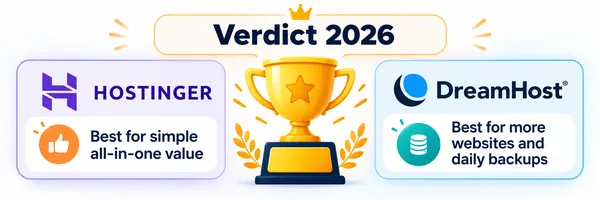
Hostinger wins on platform simplicity, integrated tools, and the strength of its long-term introductory pricing. DreamHost wins on entry-level resources, daily backups, and website count. Neither is automatically better for every user.
Choose Hostinger if you want to launch quickly and prefer one polished dashboard for WordPress, domains, email, security, CDN, migration, and AI-assisted site building. Choose DreamHost if you expect to host many sites, value NVMe storage and daily backups from day one, and prefer a shorter initial commitment.
For a broader view of the market, see our best web hosting comparison 2026. You can also verify the latest pricing directly on the official Hostinger web hosting page and the official DreamHost pricing page.
FAQ
Is Hostinger or DreamHost better in 2026?
Hostinger is better for users who prioritize a polished all-in-one platform, low long-term introductory pricing, CDN, and hPanel. DreamHost is better for users who prioritize more websites, NVMe storage, daily backups, and shorter initial commitment.
Which is cheaper, Hostinger or DreamHost?
Hostinger Premium is currently $2.99 per month on a 48-month term and renews at $10.99. DreamHost Launch is currently €2.89 per month for the first year and renews at €10.99. Currency and contract length make the comparison more important than the headline number.
Which is better for WordPress, Hostinger or DreamHost?
Hostinger offers a more integrated managed WordPress experience through hPanel, CDN, LiteSpeed, migration, and AI tools. DreamHost also supports WordPress well and gives you more websites, NVMe storage, and daily backups on Launch.
Is DreamHost or Hostinger better for a small business?
Hostinger is easier for businesses that want a simple launch process and integrated tools. DreamHost can be better for businesses managing many websites or prioritizing daily backups and larger entry-level resource allowances.