
Best web hosting for small business in 2026
A slow-loading website doesn’t just frustrate visitors it directly bleeds revenue. Finding the best web hosting for small business websites is essential if you want fast loading speeds, better SEO rankings, and a professional online presence in 2026. For a small business, your website is your hardest-working employee : Choosing the best web hosting for small business websites can improve performance, security, and long-term scalability. it handles inquiries, processes sales, and builds trust at 2 AM while you sleep. If your hosting provider cuts corners on uptime or security, you aren’t just looking at a technical glitch; you are looking at lost customers and a damaged reputation.
Shared hosting might be fine for a hobby blog, but a business demands more: professional email addresses, staging environments for safe updates, and enough horsepower to handle sudden traffic spikes from a successful marketing campaign.
While our comprehensive review of the best web hosting services breaks down the top providers across all categories, this guide zeroes in on plans specifically engineered for business growth, security, and professional polish.
After extensive testing, SiteGround stands out for its unbeatably responsive support and business-focused tools that keep you off the phone with tech support and focused on your clients.
Below are the best web hosting for small business providers based on speed, support, uptime, and business-focused features.
Top 5 Best Web Hosting Providers for Small Business in 2026
These platforms offer business-grade features like dedicated IPs, team management, and e-commerce integration without jumping to an expensive enterprise tier.
1. SiteGround
Best for hands-off business management
For startups looking for affordable small business web hosting, Hostinger offers one of the best balances between price, performance, and scalability.
SiteGround is widely considered one of the best web hosting providers for small business owners because of its reliability, strong uptime, and beginner-friendly management tools.
SiteGround has built its reputation on support that actually solves problems in minutes, not hours. For a business owner who doesn’t have an IT department, that is gold. Their GrowBig and GoGeek plans are purpose-built for companies, packing advanced caching, staging tools, and white-label client access.
Pros :
- Unmatched support : 24/7 chat and phone resolved over 90% of our test queries on the first contact.
- Speed tech : Google Cloud infrastructure plus custom SuperCacher delivers sub-500ms load times out of the box.
- Collaboration : Add collaborators with individual logins perfect for agencies or teams.
Cons :
- Renewal spike : The jump from promotional to standard rate is steep; sign up for 24 or 36 months to lock in savings.
- Storage caps : Even on the highest shared plan, you get 40GB, which might feel tight for media-heavy sites.
Ideal for : service businesses, agencies, and anyone who values rapid expert support.
Price : starts at $3.99/mo (GrowBig) on a 12-month term, renews at higher rate.
Verdict : the premium day-to-day business experience.
[Get SiteGround for your business]
2. Bluehost
Best for WooCommerce and online stores
Bluehost remains one of the best web hosting for small business options for entrepreneurs building an online store with WordPress and WooCommerce.
If you plan to sell products directly from your website, Bluehost’s WooCommerce-optimized plans remove the heavy lifting. They pre-install WooCommerce and a storefront theme so you can start adding products immediately. Their latest WooCommerce hosting also includes a free domain, SSL, and dedicated IP exactly what a professional store needs.
Pros :
- E-commerce ready : Pre-configured WordPress + WooCommerce with integrated payment gateways.
- Free Premium CDN : Included Cloudflare CDN accelerates global product pages.
- Marketing perks : Free $200 Google Ads credit and Microsoft Advertising credits.
Cons :
- Admin overhead : Some features require you to navigate upsells during checkout.
- Mixed support : While available 24/7, chat hold times can occasionally exceed 5 minutes.
Ideal for : Retail stores, physical product vendors, and anyone selling online.
Price : WooCommerce hosting starts at $9.95/mo (often discounted to ~$5.45/mo first term).
Verdict : The easiest way to launch a professional online store.
[Start your store with bluehost]
3. Hostinger
Best for scalability on a budget
Many business owners start small. Hostinger’s “Business Web Hosting” tier gives you a free domain, 100 email accounts, and a daily backup system for a price that’s still cheaper than most competitors’ basic plans. When you outgrow shared limits, their cloud hosting plans start at just a few dollars more and offer dedicated IP and server resources.
Pros :
- Business email included : 100 professional email accounts on the business plan not an add-on.
- AI tools : Built-in AI content writer, heatmap, and logo maker speed up campaigns.
- Seamless upgrade path : One-click migration to VPS or cloud hosting without downtime.
Cons :
- Phone support : Live chat is excellent, but phone support is not available for all regions.
- Long-term commitment : Best prices require a 48-month upfront payment.
Ideal for : Lean startups and SMBs that want room to grow without early heavy investment.
Price : Business Shared Hosting from $2.99/mo (48-month term).
Verdict : Remarkable value that scales with you.
[Explore Hostinger Business Plans]
4. DreamHost
Best for web developers and custom setups
DreamHost offers shared hosting that feels more like a lightweight VPS. Their business-oriented “DreamPress” (managed WordPress) and VPS plans give you isolated resources, SSH access, and unlimited bandwidth critical if you’re running custom web apps or client sites that can’t afford to be throttled.
Pros :
- Transparent pricing : Monthly billing option without massive markups; renewal rates stay reasonable.
- Unlimited bandwidth : No arbitrary traffic limits on shared or VPS plans.
- Carbon-neutral : For businesses that care about environmental footprint, DreamHost is a plus.
Cons :
- No cPanel : Custom control panel requires adaptation, especially for non-dev users.
- Support channels : Live chat limited to certain hours; phone callback only.
Ideal For : Tech-savvy founders, developers, and agencies.
Price : Shared starts at $2.59/mo; managed DreamPress at $16.95/mo.
Verdict : Developer-friendly flexibility with honest pricing.
[Check dreamHost business offers]
5. A2 Hosting
Best for need-for-speed businesses
A2 Hosting’s “Turbo” servers promise up to 20x faster page loads compared to standard shared hosting. They use NVMe storage, LiteSpeed web server, and a performance-optimized stack that even compresses images on the fly. For businesses where page speed directly correlates with conversion (think local services, SaaS landing pages), this edge matters.
Pros :
- Raw speed : Turbo servers consistently deliver LCP (Largest Contentful Paint) under 1 second.
- Developer tools : Pre-installed Node.js, Python, and PHP selectivity.
- Anytime money-Back : Prorated refund beyond the standard 30 days.
Cons :
- Turbo cost : The turbo plans cost significantly more than basic shared.
- Dashboard clutter : The cPanel interface can feel dated and packed with icons.
Ideal For : Businesses where page speed is a top competitive advantage.
Price : Turbo Boost from $6.99/mo (renews at $20.99/mo).
Verdict : Blistering speed worth investing in.
[Try A2 Turbo Hosting]
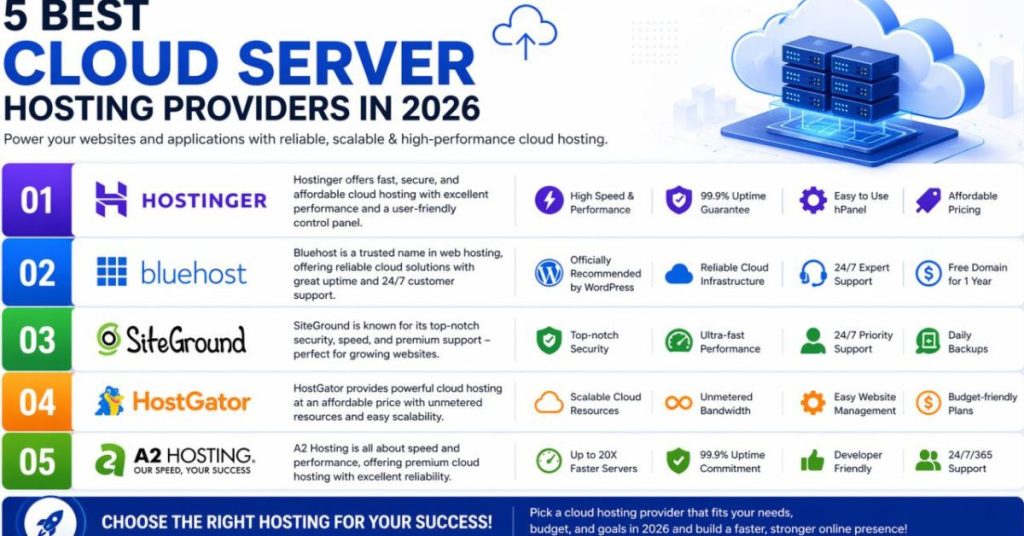
Quick comparison table
This comparison highlights the best web hosting for small business websites based on pricing, scalability, support, and eCommerce readiness.
| Provider | Best For | Starting Price* | Business Email | Free SSL | Staging | E-commerce Ready |
|---|---|---|---|---|---|---|
| SiteGround | Premium support & management | $3.99/mo | Yes (GrowBig+) | Yes | Yes | WooCommerce |
| Bluehost | WooCommerce stores | $5.45/mo | Yes | Yes | Yes | Yes (native) |
| Hostinger | Affordable scalability | $2.99/mo | 100 accounts | Yes | Yes | Yes |
| DreamHost | Developers & agencies | $2.59/mo | Included | Yes | No (on shared) | WordPress |
| A2 Hosting | Blazing fast sites | $6.99/mo | Yes | Yes | Yes | WooCommerce |
- Price reflects introductory rate with longer-term commitment.
Which Is the Best Web Hosting for Small Business in 2026?
The solo service provider (coach, consultant, freelancer)
You need a site that works while you’re with clients. SiteGround (GrowBig) will offload tech headaches with stellar support, so you rarely touch the backend. The collaboration tools also make it easy if you later hire a web designer.
The growing E-commerce brand
You need to match inventory with a storefront that loads instantly. Bluehost’s WooCommerce plan removes the integration guesswork. Over 10,000 products? Consider A2 Hosting Turbo for speed under load.
The bootstrapped startup
You have capital discipline but expect fast growth. Hostinger Business gives you professional email, daily backups, and a one-click upgrade to cloud hosting when you hit viral traffic all for the price of a basic plan elsewhere.
The digital agency or developer
You juggle multiple client sites and loathe price surprises. DreamHost offers unlimited bandwidth, month-to-month billing, and a clean VPS pipeline. It’s built for those who know their way around SSH but still want a safety net.
Remember, the most expensive mistake you can make isn’t the monthly bill; it’s picking a host that goes down during your product launch or doesn’t provide the support to fix a crashed checkout page. For a broader perspective on how these providers stack up across all categories including dedicated and enterprise options refer back to our full ranking of the best web hosting services.
Choosing the best web hosting for small business websites depends on your budget, traffic goals, and technical needs. SiteGround remains an excellent all-around solution for reliability and support, while Bluehost is ideal for WooCommerce stores and Hostinger delivers strong value for startups.
The right hosting provider can improve website speed, customer trust, SEO rankings, and overall business growth in 2026. Overall, choosing the best web hosting for small business owners can significantly improve website performance, customer experience, and long-term business growth.
FAQ
Do small business websites need a dedicated IP?
Not necessarily for most small businesses. A dedicated IP is useful if you process payments directly on your site (to meet PCI compliance), plan heavy email marketing (to protect your sending reputation), or require SSL for sensitive apps. Bluehost’s WooCommerce plan includes a dedicated IP, which is a plus for store owners.
Can i use my business email (name@company.com) with these hosts?
Yes. SiteGround, Hostinger, and A2 Hosting include professional email accounts tied to your domain on their business plans. DreamHost also provides free email. Avoid providers that charge extra for this a business email should never be a premium add-on.
What is the best web hosting for small business websites?
The best web hosting for small business owners depends on their goals, budget, and traffic needs. SiteGround is ideal for support and reliability, Bluehost is excellent for WooCommerce stores, and Hostinger offers affordable scalability.
How do I migrate my existing business site without downtime?
Most of these providers offer free or low-cost automated migration tools. SiteGround has a dedicated WordPress migrator plugin; DreamHost and A2 Hosting will often perform one manual migration free. To avoid downtime, start the migration during off-peak hours and keep your old host active for 48 hours while DNS propagates.
What’s the difference between “shared” and “managed WordPress” for business?
Does web hosting affect SEO rankings?
Yes. Website speed, uptime, and server stability directly impact user experience and Google search rankings. A slow or unreliable hosting provider can increase bounce rates and reduce your website visibility in search results. Tools like Google PageSpeed Insights help analyze website performance and loading speed.
Shared hosting means your site lives on a server with hundreds of others, sharing CPU and RAM. It’s fine for brochure sites with moderate traffic. Managed WordPress (like SiteGround GoGeek or DreamPress) offers isolated resources, automatic updates, and caching tuned specifically for WordPress essentially a “VIP lane” that reduces security risks and speeds up admin tasks. For business sites driving revenue, managed is the safer bet.
Investing in the best web hosting for small business websites is essential for improving SEO rankings, customer trust, and online sales in 2026.